

Why starting an online business is easy—but staying consistent is hard. Learn why structure beats motivation and how to simplify your next steps.
Affiliate Disclosure: Guess what? When you click and buy through our links, you’re doing more than improving your game. You’re supporting us in a way that doesn’t cost you extra but helps us keep bringing you the best drills and tips. It’s a slam dunk for both of us!

Most people don’t fail at building an online business because they can’t start.
They fail because they start too many times.
Getting started usually feels exciting. You watch a video, read a post, or hear someone’s story and think, “I can do this.” And you probably can.
But after the initial momentum fades, something harder needs to show up: consistency.
Table of Contents
- Why Does Getting Started Feel Easy?
- Why Consistency Is the Real Challenge
- The Role of Information Overload
- A Simpler Way to Think About Progress
- Final Thoughts
Why Does Getting Started Feel Easy?
Getting started feels good because it comes with clarity and hope. The path looks short. The steps seem obvious. Motivation is high because nothing has had time to get complicated yet.
At this stage, people are imagining outcomes, not managing systems. That optimism is real—and it’s not a bad thing. Starting is important.
The trouble begins later, when the easy momentum wears off.
Why Consistency Is the Real Challenge
Consistency requires showing up when progress feels slow and unclear.
After the first burst of energy, questions start to pile up:
- Am I doing the right thing?
- Should I be further along by now?
- Is there a better way than this?
Without a clear structure, those questions lead to hesitation, restarts, and frustration. Not because people are lazy or incapable—but because the path forward no longer feels obvious.
The Role of Information Overload
One of the biggest threats to consistency today is too much information.
There are endless videos, tools, platforms, and opinions—many of them useful on their own, but overwhelming together. Instead of helping, they often create noise.
When everything feels important, nothing feels clear.
People don’t stop because they lack interest. They stop because they don’t know which step actually matters next.
A Simpler Way to Think About Progress
Here’s a reframe that made a real difference for me:
You don’t need more motivation.
You need fewer decisions.
Progress becomes calmer when you choose one direction and reduce distractions. Fewer tools. Fewer comparisons. Fewer restarts.
Staying consistent isn’t about doing more—it’s about removing what gets in the way.
Infographic: Getting Started vs Staying Consistent
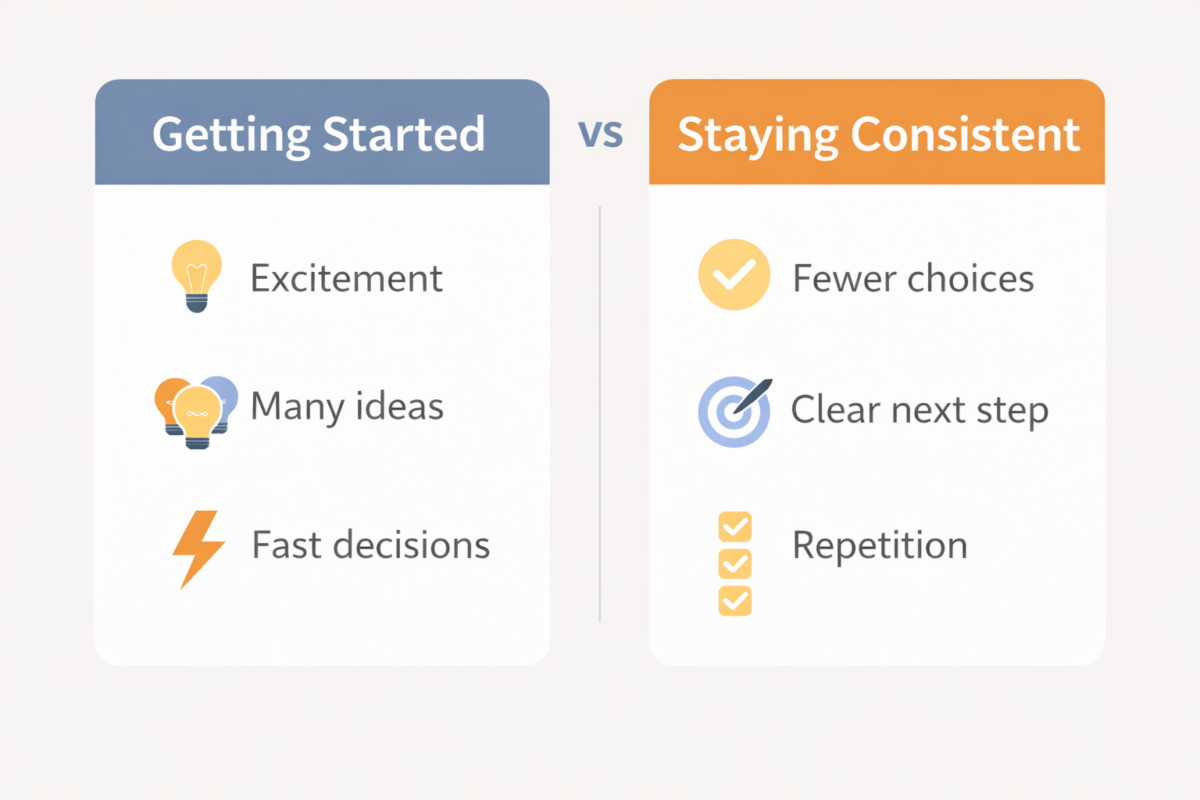
Table: Why Consistency Breaks Down
| Challenge | What It Looks Like | What Helps |
|---|---|---|
| Too much information | Watching endless videos, reading conflicting advice | Choosing one system |
| Too many decisions | Constantly switching tools or strategies | Clear next steps |
| Motivation fades | Early excitement wears off | Simple routines |
| Restarting often | Starting over instead of continuing | Finishing what you start |
Final Thoughts
If you’ve started before and stopped, it doesn’t mean you failed.
More often, it means you didn’t have enough structure to support consistency.
This site documents what it’s actually like to slow down, simplify, and keep moving forward—one step at a time, without hype or shortcuts.
This Is an Ongoing Process — Not a Finished Story
I’m not writing this from a place of having everything figured out.
I’m documenting what it’s actually like to simplify, focus, and follow through — without hype and without shortcuts.
Some weeks move faster than others. Some lessons take longer to sink in. That’s normal.
What matters is staying on one path long enough for it to work.
This article is part of an ongoing series documenting what actually helps people build momentum online without hype or shortcuts.
What Do You Think?
I’d love to hear your thoughts about this article. Can you relate? Can you see yourself in it? Leave comments and questions in the space below.
I always reply.
#onlinebusiness #startingabusiness #stayingconsistent #informationoverload #beginnerbusiness #onlinebusinessover50 #simplifybusiness #digitalmarketingbasics #seniorentrepreneurship #consistencyovermotivation
This really resonated with me, especially the line “They fail because they start too many times.” That feels uncomfortably accurate. Starting does come with clarity and optimism because nothing has been tested yet—no friction, no uncertainty, no need for systems. Once that wears off, consistency suddenly asks for a very different skill set.
I also appreciated the way you reframed motivation. The idea that progress breaks down not because of laziness, but because of too many decisions, feels spot-on in today’s information-heavy space. It made me pause and think about how often “research” is really just another form of avoidance when the next step isn’t clearly defined.
Your point about structure quietly doing the work that motivation can’t was grounding. It raises a question for me: how do you personally decide when a structure is simple enough versus when it’s just another layer that looks helpful but eventually becomes noise? At what point do you lock something in and stop tweaking?
I also liked the honesty in the closing—documenting the process rather than presenting a polished success story. That transparency makes the message more believable, and honestly more encouraging. It reminds me that consistency isn’t about intensity or speed, but about staying with one path long enough for it to reveal something real.
Curious to hear how others reading this define “enough structure” for themselves—and what helped them stop restarting.
Hi Iris, thanks for your comments. I’m glad this resonates with you.
To address your question: Your use of the word “simple” is the key. Unfortunately, the answer is often not simple or easy. The truth is, I often don’t know and I need all the help I can get to figure it out. That is why I employ my go-to company, WA, so when I get stuck, which is often, I turn to the WA community. I also have come to rely on my AI assistant to help me see what I am unable to see. Even then, it’s not to say, I fully understand.
This all points to the concept of consistency. I’ve had to learn the hard way, that quitting and/or giving up is not an option. If I stay with whatever it is that stumps me, I eventually find the answer(s) I’m seeking. Sometimes it’s simple. Sometimes it isn’t.
Bob